With El Niño bearing down, I got a free LA County engineering assessment at home. What I learned
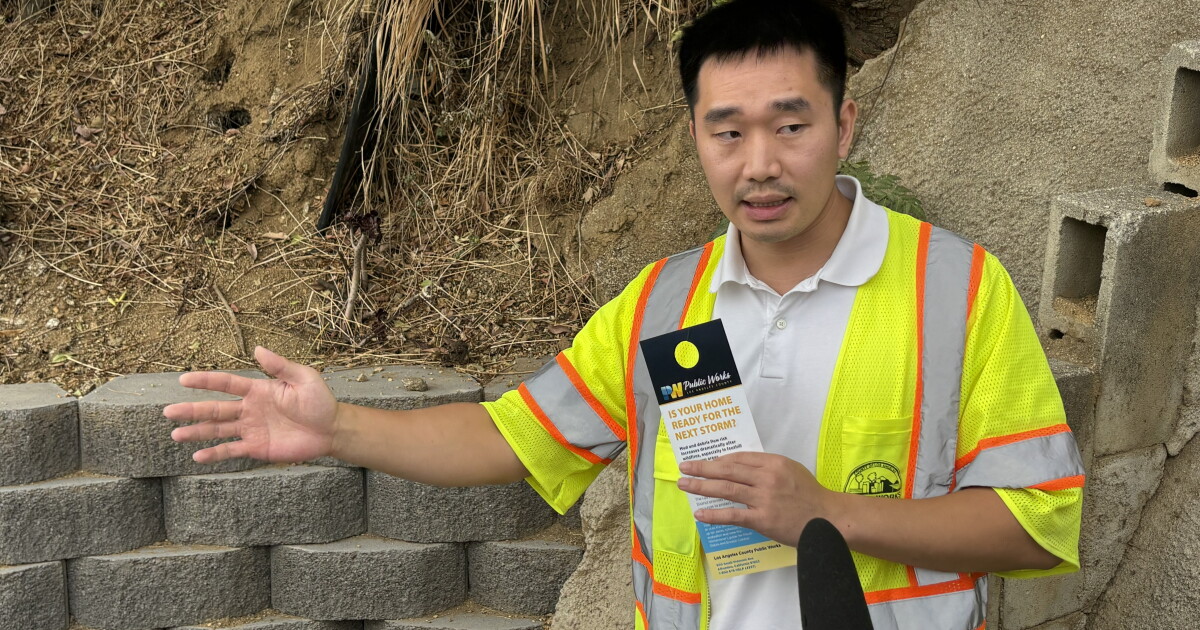
L.A. County civil engineer Eden Ly shares how water may flow at a property below a steep hillside. (Kerjon Lee / L.A. County Department of Public Works)A pair of Los Angeles County engineers knocked on my door a couple of weeks ago and handed me a booklet about how to prepare for flooding and mudflows. They also told me they offer free, specific engineering advice for individual properties.I was definitely interested in this — I live in a neighborhood affected by the Eaton Fire, and the house I rent is tucked right against a steep hillside with vegetation that burned.A few days later, two engineers, as well as the county’s public information officer, showed up at my door.Eden Ly, a civil engineer with the county, looked up at the mountainside looming above my house.“This mountainside is very steep, and that's the scary part,” Ly said.The more recent the burn scar, the steeper the hillside and the closer your house is to it, the bigger the danger. The good thing, Ly said, is that much of the vegetation looked pretty recovered from the fire, so the roots should hold onto the dirt. And the property has a retaining wall that Ly said looks solid.L.A. County civil engineer Eden Ly, right, assesses a retaining wall behind the house of reporter Erin Stone in a neighborhood affected by a recent wildfire. (Kerjon Lee / L.A. County Department of Public Works)Before coming to do a scheduled assessment of a resident’s property, Ly said he and his team analyze all kinds of data to understand how water — and thus mud and debris — may flow there.“This will include a lot of geospatial information, a lot of mapping, such as topography,” Ly said. It also includes, Ly said, historical rain gauge data to understand how intense rain tends to be in different areas, soil types and more.So far this season, Ly and his team have knocked on the doors of over 700 homes — 233 homeowners have received walk-through assessments of their properties, said Kerjon Lee, a spokesperson for the county’s Public Works Department.“A lot of this data isn't public,” Ly said. "And even if it was public, how is the average Joe going to be able to understand what's going on? So our job is to try to bridge that gap.”By Ly’s analysis, the terrain above my place is gravelly and muddy, not big boulders that can tear through a house. So if the hill does slide, we should be spared something like the deadly mudslides Montecito experienced in 2018, after the Thomas Fire.“It's more of that kind of mud flow, that mud river that is more the concern in this case,” Ly said.He suggests various areas to strategically place plywood planks and sandbags. I’m a renter, so there’s not much else I can do.What if I have to leave?Then Ly pointed to a weak spot that could lead to mud flowing where we park our cars.“Heavy storm; we will probably recommend you try not to be there,” he said.In a strong storm like that, I expect my neighborhood will get evacuation warnings — at least.This winter, warnings or even orders to leave could become common.Half an inch of rainfall in less than an hour — or more than 3 to 4 inches in a day — can trigger debris flows after a recent wildfire.But that’s just a rule of thumb. As bare dirt becomes more saturated with back-to-back storms, less intense rainfall can be a trigger. So in addition to the engineering assessment and prep work, paying attention to forecasts and knowing how water flows where you live is key.“Our best advice is that you try to deflect and guide everything,” Ly said. But “it's Mother Nature; you can't stop it.”Talk to neighborsOverall, Ly tells me the swales my landlord built behind the house, and those my neighbors built, look like they’ll direct water and mud to the street, which is generally the goal.And that’s another piece of advice he gives — talk to my longtime neighbors, who have been through a storm or a few.Ly tells me his team will email a more detailed report once they dig into a little more data. That’s part of the free service for higher-risk homes.In addition to the plans I’ve got for our pets, important medications, possessions and other things I'll need if we have to evacuate, the county's assessment left me with valuable advice — and a little less anxiety too.
Take Your Experience to the Next Level
NewDownload our mobile app for a faster and better experience.
Comments
0U
Join the discussion
Sign in to leave a comment