Can we escape the web of research denial?
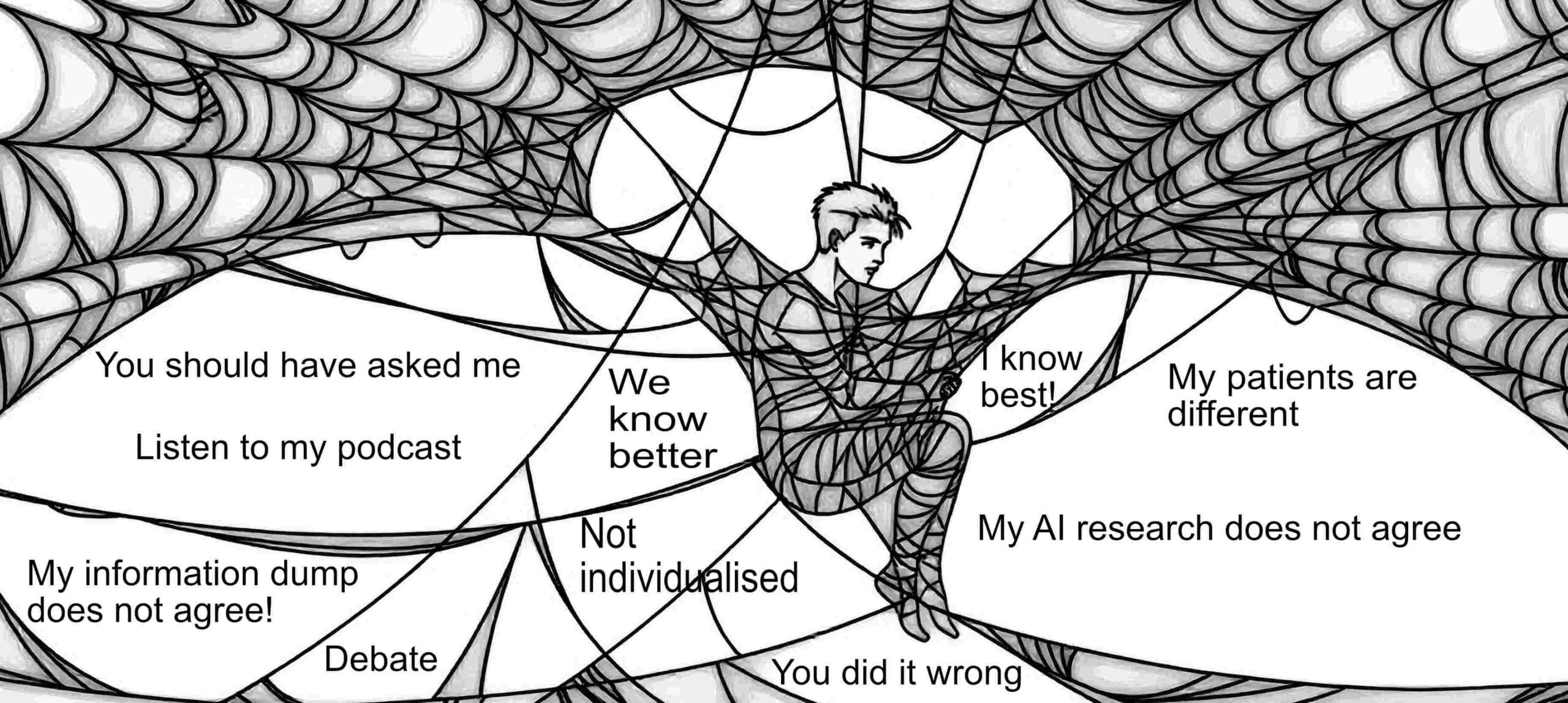
This is another follow-up post related to my recent lecture at the European Orthodontic Society Congress. Since then, I’ve been thinking a lot about my presentation. I want to revisit an earlier topic I’ve discussed: the reasons people reject high-quality research findings. I first shared some thoughts about this ten years ago, introducing the idea of the pyramid of denial. However, now I believe the situation is more complicated, and I’d like to talk about what we shall call the ‘Web of denial.” I have based this on feedback from questions posed at lectures, discussions on social media, and informal conversations with respected figures in orthodontics over the past 15 years. These are the reasons people or groups of like-minded “followers” do not accept research findings. So here is the web of denial. This has trapped me for several years. I recently decided to stop engaging with these people, and my life is much simpler and happier. The web of denial. I/we know best This means that a person simply does not agree with the research findings. They prioritise their clinical experience over the research. In short, they are so confident in their clinical experience that they completely ignore research. This is the lowest level of rebuttal and perhaps reflects a degree of arrogance or ignorance of research methods. Unfortunately, this approach is becoming more common. This is a current tactic of the more extreme members of the airway-friendly community. Perhaps this reflects the way that modern politics is conducted. You should have asked us? I first became aware of this issue when we published the results of our studies on Class II treatment. After I had given conference presentations, it was not unusual for people to discuss my lecture. It was also common for delegates to express disappointment with our findings. Several felt it was regrettable that we had not consulted them about the treatment. They believed we had made mistakes in the design of our appliances and in the choice of mechanics. I even had someone stand up at the end of a lecture and say that “the reason we did not get much skeletal change from a Twin Block was because the design of the lower molar clasps was not correct.” They believed their advice would have kept the studies on the right track and that the findings would have agreed with their perceptions. You did it wrong? This was a rather blunt comment, and they stated that the study was flawed. Strangely, when I challenged them to point out the flaw, they could not do so. Importantly, they put forward baseless reasons for rejecting research findings. For instance, they might feel that there were no relevant outcomes related to the treatments in which they believed . In effect, we had measured the wrong things. Theie other approach was to identify one minor flaw in the study and ignore the overall evidence. These tendencies are becoming more common and are still baseless. We would like a debate The orthotropic dentists in the UK used this technique. It has recently been adopted by other airway orthodontists in the USA. The first step is to claim that the research is flawed. When this viewpoint is challenged, they ask for a debate. Occasionally, I and others, have agreed to this, but it has been a complete waste of time because the debate is a one-way conversation with a zealot who does not listen and simply expounds their theories ad nauseum. A complete waste of time. You just need to listen to my podcast This is a new social media approach to addressing research and is used in the USA. It is similar to asking for a debate. These people suggest that you listen to their podcast. I have looked at these, and they contain about 90 minutes of rambling discussion by one or more people who do a great job of misinterpreting the literature. In effect, they create a wall of irrelevant white noise. Again, a complete waste of time. The study is not individualised A common criticism of trials is that participants are treated as mere numbers rather than as patients who need individualised care. As a result, treatment protocols are so strictly defined that care cannot be tailored to individual needs. This means that the investigators do not evaluate the true “art of orthodontics”. I believe this is incorrect. We must remember that trial operators have an ethical obligation to provide the best possible care to patients. This means they need to adapt their methods to ensure optimal treatment. Additionally, this approach helps maintain the study’s external validity. Furthermore, it would be unethical for them to treat a patient strictly according to the study protocol if they recognise that it could cause harm. My patients are different. This is when the person dismisses the findings because they are not applicable to their patients. This suggests that their patients differ significantly in genetic, sociological, and morphological aspects from those involved in the trial. There is not much more to elaborate about this ridiculous concept. My AI-powered search does not agree. This is a new one. They simply load the subject into their favourite AI system and ask for an appraisal of the evidence. However, these appraisals currently include all levels of evidence. As a result, the conclusions are not always correct. I realise that this area is changing rapidly and that AI appraisal is likely to become more accurate. At the moment, it is not, and anyone who adopts this approach is somewhat naive. My information dump of papers does not support your findings. This is another new method of denial. It involves downloading many references and abstracts and simply dumping them into a conversation without any critical appraisal or even reading the references. This overloads anyone having a discussion, and they tend to give up. Several Facebook-based orthodontists make extensive use of this tactic. Pyramid of denial bingo When I read the comments on a study, I often play a game similar to bingo by tallying the number of times “denial” is mentioned. I can’t help but notice a correlation between the frequency of these “denial” references and the level of quackery present. Final thoughts We need to remember that research is not automatically correct; studies can be flawed, but objections should be grounded in genuine critical appraisal: study design, bias, sample, outcomes, effect size, applicability, and replication. This is genuine scientific debate. I thought that it would be worth revisiting these points so that we can refresh our memories. Let’s chat about this in the comments.The post Can we escape the web of research denial? appeared first on Kevin O'Brien's Orthodontic Blog. CommentsIn reply to Jeff Rouse. It is rather ironic to see this ... by Vishnu RajThere are two issues here. First, the philosopher Bertrand ... by John Richard PilleyIn reply to Jeff Rouse. Yes, I agree with you. It is likely ... by Kevin O'BrienThe error in your premise is that you have established your ... by Jeff RouseDear Prof Kevin O'Brien, You should consider adding 1 more ... by JasonPlus 5 more...Related StoriesLet’s look at the waves of orthodontic quackery?An interesting study looks at orthodontic treatment harm.When Snoring Is More Than Snoring: Sleep Breathing Problems in Children
Take Your Experience to the Next Level
NewDownload our mobile app for a faster and better experience.
Comments
0U
Join the discussion
Sign in to leave a comment