Generative engine optimization KPIs that actually matter for marketing teams
Generative AI is changing how people discover brands, products, and information. Because it disrupts the buyer journey, it requires new metrics, specifically GEO KPIs, that accurately reflect performance within these AI engines.
With Google AI Overviews appearing in over 20% of searches, marketing leaders are now being asked new questions by executives: Are we showing up in AI answers? Are we being cited? Or are AI engines recommending our competitors?


As search behavior shifts, traditional SEO KPIs alone can no longer explain visibility or downstream revenue impact.
This guide breaks down the GEO KPIs that actually matter, how to measure GEO success, and how to connect AI visibility to business outcomes using tools that marketing teams already trust, including HubSpot AEO.
Why GEO KPIs Matter Now
As generative AI becomes a primary decision layer in the buyer journey, generative engine optimization (GEO) KPIs become important performance indicators. According to OpenAI, nearly half of all ChatGPT usage falls into the “Asking” category, where users rely on AI for advice, evaluation, and guidance rather than simple task execution.
For many users — 61% of them — these “asks” are product recommendations. This means brand preference is influenced by AI-generated answers, often before a prospect visits a website.
Traditional marketing KPIs don’t capture this layer of visibility. Without understanding where and how often a brand appears in AI answers, it can be challenging to create a strategy to regain or maintain that influence.
From my experience, maintaining visibility inside AI-answers engines is fragile without a deliberate GEO strategy. After a targeted content update on my own site, I saw my content begin surfacing ahead of long-established industry publishers in AI-generated answers within 96 hours — without any corresponding jump in traditional search rankings.
If I had been tracking SEO metrics alone, I would have missed that change entirely. GEO KPIs exist to pinpoint these shifts before they translate into lost authority or, worse, downstream revenue impact.
Generative Engine Optimization KPIs to Track
The metrics below reflect how AI search behaves in the real world and give teams a clearer, more honest way to evaluate how their brands appear in AI-generated answers. Key metrics for measuring GEO success include AI citation frequency, answer inclusion rate, entity authority signals, AI referral traffic, AI share of voice, and AI-driven leads.
To understand which GEO KPIs and metrics actually hold up, I spoke with Kristina Frunze, founder of WebView SEO, in a recorded interview for the Found in AI podcast.
1. AI Citation Frequency
AI citation frequency tracks how often a brand is named directly in AI-generated answers across large language models (LLMs). Direct brand mentions are the most reliable signal that an AI engine recognizes and recalls a brand.
What the Experts Say: Frunze told me, “For the purpose of AI citations, at the moment, direct brand mentions are the best way to track it. The tools are evolving, and they’re not 100% accurate, but this is what we can rely on right now.”
How I use the metric: I use citation frequency as a baseline trust signal. If a brand isn’t being named at all, no amount of traffic or conversion optimization matters yet. But since I have a sense of where a brand should appear, I can track changes over time.
For a brand that already appears inside AI answers, I track changes in citations after content updates to see whether AI engines recognize the brand as a legitimate source or cite it more often.
How to track: Monitor direct mentions of a brand in AI-generated answers using tools like HubSpot AEO, XFunnel, Addlly AI, or Superlines. Track changes over time after content updates to see whether AI models increasingly recognize and cite the brand.
Pro tip: Use HubSpot SEO Marketing Software to align cited pages with topic clusters and internal linking. A strong topical structure increases the likelihood that AI systems will consistently associate your brand with specific subjects.
2. AI Answer Inclusion Rate
AI answer inclusion rate measures how often a brand appears anywhere in an AI-generated response, even when no direct citation or link is provided. This generative engine optimization metric captures presence and relevance, not attribution alone.
What the Experts Say: Frunze explained, “If you just look at your AI citations, you’re missing the bigger picture.” She explained that metrics, like AI answer inclusion rate, help brands understand “what their competitors are doing and how they stand against them in LLM search.”
How I use the metric: I use the inclusion rate to assess whether AI models consider a brand part of the conversation. Inclusion without citation often indicates early-stage authority, which can later translate into citations as content clarity improves.
How to track: Capture all instances where the brand appears in AI responses, whether or not it’s cited, using multi-platform monitoring tools. Compare inclusion trends over time and across competitors to understand early-stage visibility and relevance.
Pro Tip: HubSpot AEO‘s Brand Visibility Dashboard tracks how often your brand appears in AI-generated answers, including instances where the brand is present but not directly cited. Track inclusion trends alongside assisted conversions in HubSpot analytics to understand how early-stage AI presence is influencing downstream pipeline activity.
3. Entity Authority Signals
Entity authority signals measure how consistently AI engines associate a brand with specific topics, attributes, and use cases. These associations are reflected in underlying knowledge graphs and reinforced through:
- Structured data
- Third-party mentions
- Consistent brand positioning across the web
What the Experts Say: “With AI SEO, links don’t matter as long as your brand is actually mentioned on communities, third-party websites, and directories,” Frunze said. “Getting your brand spoken about and getting it right is very important.”
How I use the metric: I treat entity authority as an off-site credibility layer. When I conduct AI visibility audits, I note where a brand is mentioned, whether the information is accurate, and whether AI-generated descriptions align with how the company positions itself.
This means I spend significant time measuring social KPIs and monitoring how users discuss a brand. One-off mentions on platforms like Reddit and Quora can appear in AI-generated answers, but it is important to understand where those comments come from and how they impact a brand’s perception.
How to track: Audit structured data, third-party mentions, and consistent brand positioning across web sources using social listening and entity-tracking tools. Measure how often AI associates the brand with specific topics, attributes, and use cases.
Pro tip: Use HubSpot’s Social Inbox to monitor brand mentions, conversations, and sentiment across social platforms in one place — and pair it with HubSpot AEO‘s Sentiment Analysis to see how those external signals are influencing how AI engines actually describe your brand. Keeping a close eye on where and how a brand is talked about helps reinforce consistent entity signals across the web.
4. AI Referral Traffic
AI referral traffic tracks sessions originating from AI platforms and passes referral data into analytics and CRM systems. While under-reported, this metric provides directional insight into how AI visibility translates into site engagement.
What the Experts Say: Frunze told me, “AI traffic is the easiest to track because it feels familiar, but there’s a lot of uncertainty because not all elements pass the proper parameters. You’re not always getting the full picture.”
How I use the metric: Direct referral traffic from AI platforms is relatively easy to spot when it’s clearly labeled as coming from tools like ChatGPT or Perplexity. In practice, though, not all AI-driven sessions provide clean referral data.
Because of that, I treat AI referral traffic as a supporting signal rather than a success metric in its own right. I look at it alongside assisted conversions and branded search lift to understand its true influence, rather than expecting clean last-click attribution.
How to track: Use CRM and analytics platforms (e.g., HubSpot, GA4) to identify sessions coming from AI tools like ChatGPT or Perplexity. Because not all AI traffic passes proper referral data, treat this as a directional metric alongside assisted conversions and branded search lift.
Pro tip: Create custom source groupings in HubSpot reporting to isolate known AI referrers and evaluate their influence across the full funnel. Pair this with HubSpot AEO’s Prompt Tracking to understand which prompts are driving citations. This gives teams a leading indicator of where AI referral traffic is likely to come from before it shows up in analytics.
5. AI Share of Voice (AI SoV)
AI Share of Voice measures how often a brand appears relative to competitors across a defined set of prompts. Marketing teams typically track this in two ways:
- Entity-based share of voice. Measures whether a brand appears at all in an AI-generated answer.
- Citation-based share of voice. Tracks how often a brand is explicitly cited or referenced.
Together, these views show which brands’ AI engines trust and rely on to generate an answer.
What the Experts Say: “AI share of voice shows how many times you come up versus your competitors for the prompts,” Frunze explained. “It helps put things in perspective.”
How I use the metric: This is the first GEO KPI I look at when diagnosing AI visibility. If competitors dominate AI responses to high-intent prompts, it usually indicates that the brand I’m working with has positioning or authority gaps.
How to track: Compare a brand’s presence versus competitors across a defined set of AI prompts using tools like XFunnel or Superlines. Track both entity-based and citation-based appearances to understand relative AI trust and authority.
Pro tip: Use XFunnel to measure AI visibility and share of voice across LLMs. Pair this data with KPI dashboards to contextualize AI exposure alongside pipeline and revenue metrics.
6. AI-Driven Leads
AI-driven leads measure conversions influenced by AI discovery, particularly for bottom-of-funnel queries such as competitor comparisons, alternatives, and integrations. This metric is most valuable for understanding how AI visibility appears in the pipeline, as these interactions typically come from buyers who are close to making a purchase decision.
What the Experts Say: Frunze mentioned, “The content that drives AI leads the most is bottom-of-funnel content. These prompts usually come from people already evaluating options and are past the awareness stage.”
How I use the metric: I use AI-driven leads to understand whether GEO work is contributing to revenue, not just visibility. I review form fills and deal creation alongside high-intent pages like comparisons, alternatives, and integrations.
Within those forms, I look for explicit references to ChatGPT, Perplexity, or Gemini. Sometimes, I ask customers where they first heard about the brand.
How to track: Connect AI referral data with lead tracking in the CRM to quantify conversions originating from AI interactions. Use UTM parameters or platform-specific identifiers to measure downstream impact on pipeline and revenue.
Pro tip: Track AI-influenced form fills and deal creation inside HubSpot CRM to understand how generative search contributes to the pipeline, even when attribution isn’t linear. Use HubSpot AEO’s Recommendations feature to prioritize which visibility gaps to close first. Each recommendation includes a full content brief tied to the bottom-of-funnel prompts most likely to drive AI-referred leads.
Quick Overview: SEO KPIs vs GEO KPIs
Best Tools to Monitor GEO KPIs Across AI Platforms
1. HubSpot AEO
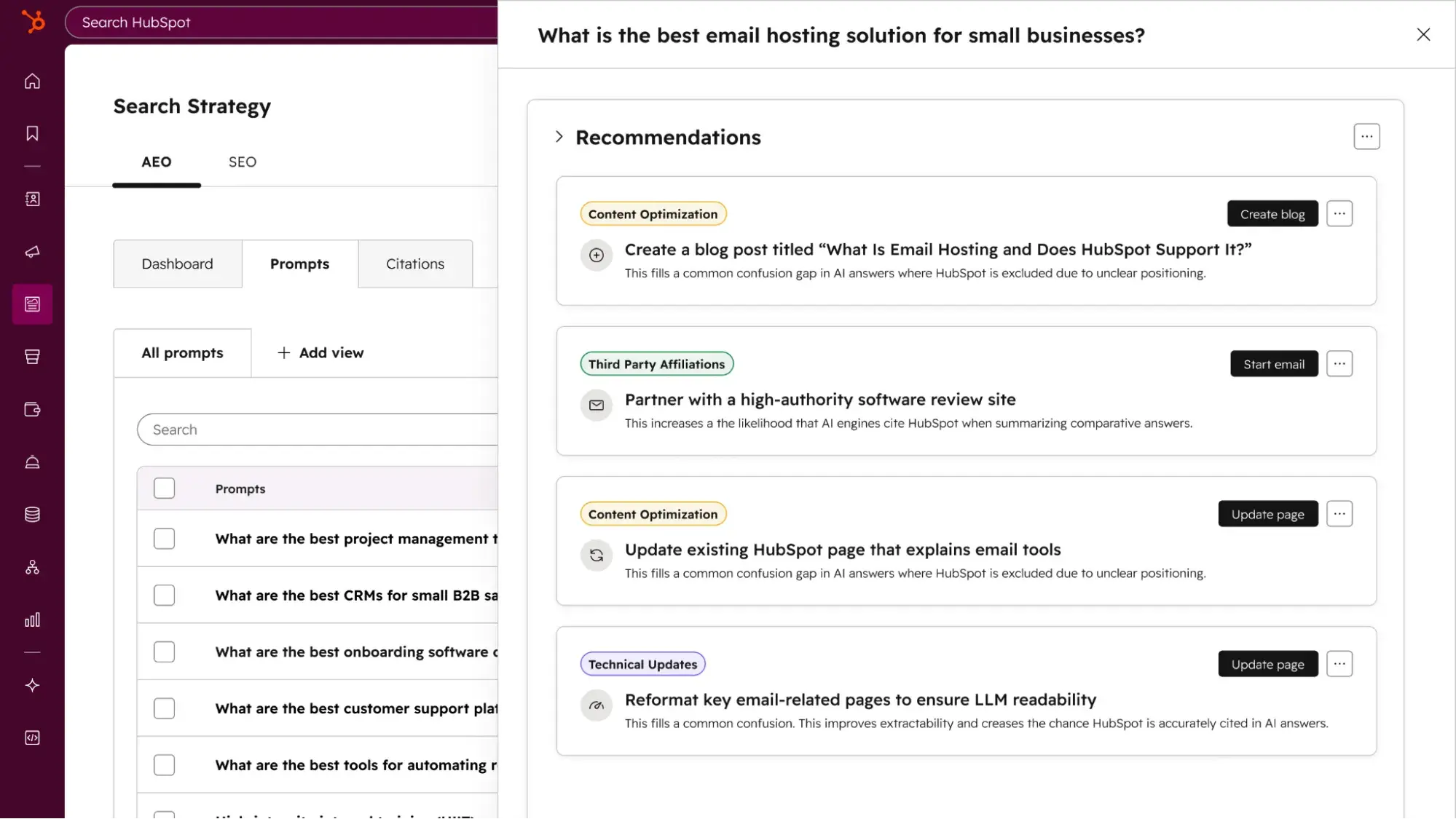
HubSpot AEO tracks and improves how a brand appears across major answer engines, including ChatGPT, Perplexity, and Gemini. HubSpot AEO directly measures core GEO KPIs, from citation frequency and AI share of voice to prompt-level prominence and sentiment.
Unlike tools that focus on a single metric or require stitching together data from multiple sources, HubSpot AEO centralizes GEO measurement in a single dashboard. This makes it possible to track performance consistently over time and connect visibility shifts directly to content and strategy changes.
Key Features:
- Brand visibility dashboard. Tracks answer inclusion rate across answer engines, showing how often the brand appears in AI-generated answers for priority prompts and how that score shifts over time
- Competitor analysis. Powers AI share of voice measurement, showing relative presence versus competitors across the same prompt set, so teams can identify where they’re gaining or losing ground
- Prompt tracking and suggestions. Monitors answer prominence and positioning at the prompt level, including which prompts cite the brand, which cite competitors instead, and where the brand is completely absent.
- Citation analysis. Surfaces which domains, content types, and source channels AI engines are pulling from when answering prompts in the category
- Sentiment analysis. Measures how positively or negatively the brand is described in AI-generated responses on a scale from -100% to +100%, giving teams an early signal of entity authority issues alongside visibility gaps
- Recommendations. Turns visibility and citation data into a prioritized action plan, with full content briefs for each recommendation so teams know exactly what to create or change to move the needle on GEO KPIs
Best for:
- Marketing teams that need a single dashboard to track GEO KPIs consistently over time
- Brands that want to connect AI visibility to pipeline and revenue outcomes without managing multiple tools
- Teams reporting AI performance to leadership who need clear, comparable data across answer engines
Pricing: Available in Marketing Hub Pro and Enterprise, or as a dedicated tool for $50/month without a HubSpot subscription.
What I like: Most GEO KPI tracking requires a combination of manual testing, spreadsheet tracking, and disconnected tools. HubSpot AEO brings the core metrics into one place so teams can monitor performance consistently rather than episodically. The centralized dashboard makes it significantly easier to show directional movement over time and connect AI
Take Your Experience to the Next Level
NewDownload our mobile app for a faster and better experience.
Comments
0Join the discussion
Sign in to leave a comment